
Custom Plush Toy Manufacturer for Brands & IP Owners
Turn Your Original Characters into Custom Plush Toys
Bring your original character designs to life with custom plush toy development and OEM/ODM manufacturing support.
Hanyang Toy works with brands, IP owners, designers and businesses to develop character plushies, mascot toys, stuffed animals and hybrid plush figures. From artwork review and pattern development to sampling, fabric selection, production and packaging, we help turn creative concepts into practical manufacturing projects.

Explore the Manufacturing Process
How Are Custom Plush Toys Made?
Discover how original characters become plush toys through pattern engineering, fabric selection, embroidery, sewing, stuffing, quality control and packaging.
Custom Plush Toys for Different Brand Applications
What is custom plush toy manufacturing? It is the development and production of soft toys made to your own design: a character or mascot is turned into fabric patterns, sewn from selected fabrics, decorated with embroidery or printing, stuffed, finished and packed to an approved sample. Hanyang Toy supports brands from artwork review to shipment through our production system and partner factories.
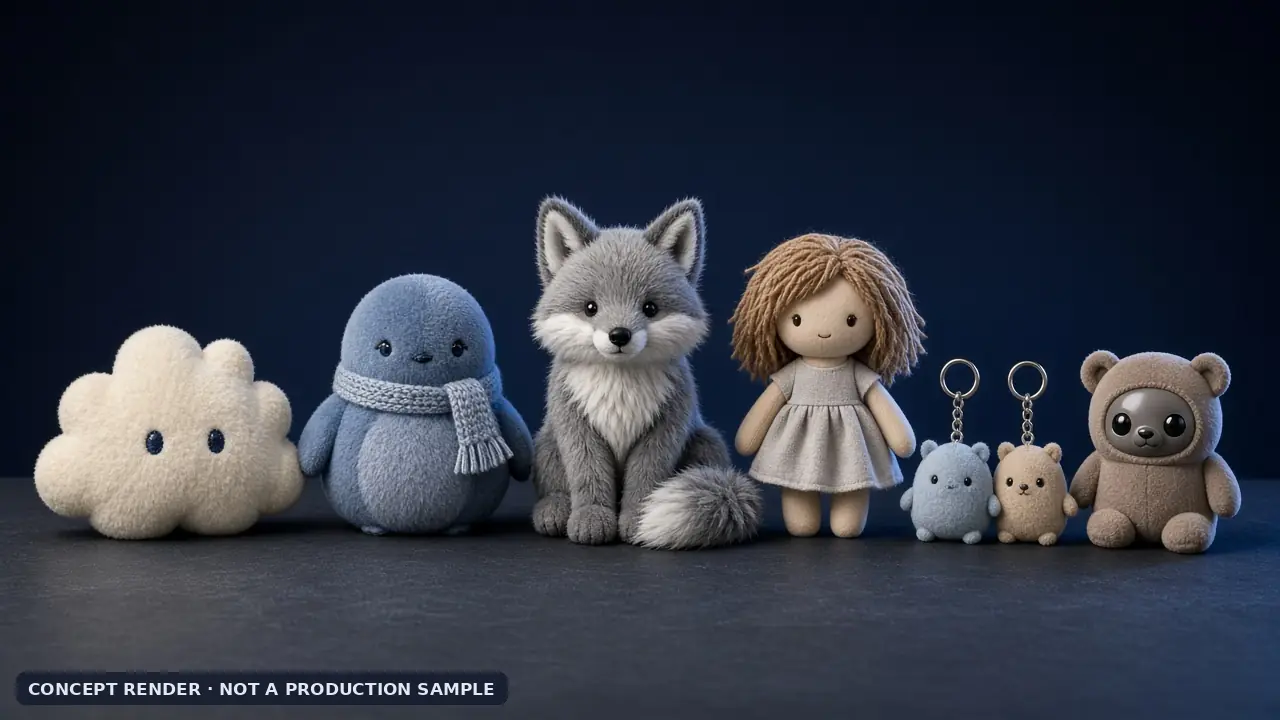
Custom Character Plush Toys
Transform original characters, mascots and illustrations into three-dimensional plush collectibles.
Suitable for- Original IP characters
- Collectible plush figures
- Character merchandise
- Entertainment brands
Custom Mascot Plush Toys
Develop recognizable plush mascots for companies, events, universities and consumer brands.
Applications- Corporate merchandise
- Brand campaigns
- Event promotions
- Licensed characters
Custom Stuffed Animals
Manufacture custom animal plush toys with selected fabrics, embroidery and stuffing specifications.
Applications- Animal character brands
- Retail merchandise
- Gifts
- Children's products where applicable
Custom Plush Dolls
Create soft dolls with custom clothing, embroidered features, character accessories and selected decorative elements.
Typical details- Custom fabric clothing
- Embroidered faces
- Yarn or fabric hair
- Character accessories
Custom Plush Keychains & Mini Plush
Develop miniature plush accessories for merchandise collections and promotional projects.
Note- Feasibility depends on size, detail, material and construction.
- Small sizes limit embroidery detail and part count.
- Differentiated capability
Hybrid Plush Figures
Combine plush bodies with selected molded plastic or other rigid components for distinctive collectible designs — one of our differentiated development capabilities.
See hybrid plush development
Customize Every Detail of Your Plush Toy
Start from your design, then specify size, fabric, decoration, filling, accessories and packaging. Each option below lists what to include in your request so the first quotation is accurate.
Character Design
Develop plush toys based on original artwork, character sheets or approved 3D references.
Dimensions
Choose a suitable product size based on character proportions, intended use and manufacturing feasibility.
Stuffing & Structure
Specify the desired shape, hand feel, fill distribution and structural requirements. Polyester fiberfill and other suitable filling systems may be evaluated according to the product.
Plush Customization Explorer
Select an option, use Previous / Next, or the arrow keys.
Fabrics
Select appropriate materials. Different materials offer different textures, pile lengths, softness and visual effects.
Options
- Minky
- Velboa
- Short-Pile Plush
- Faux Fur
- Fleece
- Other Suitable Textiles
Include in your request: Preferred texture and softness, color references (Pantone codes or physical swatches) and any reference products. Fabric and color are confirmed on swatches and samples before production.
Embroidery & Printing
Customize eyes, facial expressions, logos and decorative graphics using suitable embroidery, printing or other textile decoration methods.
Options
- Embroidered eyes, mouths and logos
- Printed fabric for gradients and fine graphics
- Appliqué and felt details
- Molded face components (hybrid plush, reviewed separately)
Include in your request: Face artwork at a clear scale, which details must stay sharp, and the intended age group — hard eyes and molded parts need a product-safety review.
Dimensions
Choose a suitable product size based on character proportions, intended use and manufacturing feasibility.
Options
- Mini and keychain plush
- Standard shelf and gift sizes
- Large display plush
- Size range across a collection
Include in your request: Target height or width and how it is measured (standing, sitting, including ears). Small sizes limit detail; large sizes add fabric, filling, carton volume and freight.
Accessories
Consider fabric clothing, tags, ribbons, decorative attachments and other product-specific accessories.
Options
- Fabric clothing and scarves
- Ribbons and sewn-in labels
- Key rings and clips
- Rigid decorative attachments
Include in your request: Accessories must be evaluated for durability and applicable product safety requirements, including attachment strength and small-part risk for the intended age group.
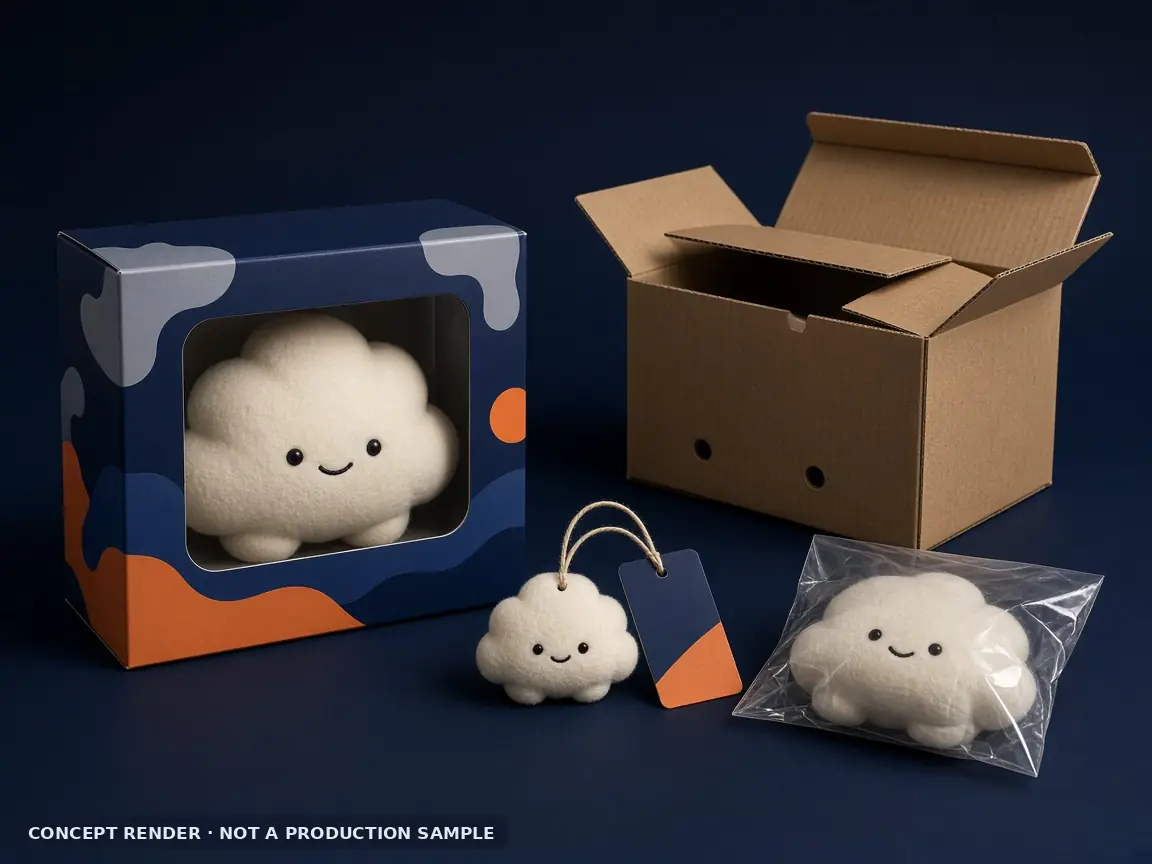
Packaging
Available project options may include the formats below. Actual packaging should follow the approved project brief.
Options
- Individual Polybags
- Custom Hangtags
- Printed Retail Boxes
- Gift Packaging
- Export Cartons
Include in your request: Retail or promotional channel, branding files, barcode and label needs, warning labels for the destination market, and carton requirements.
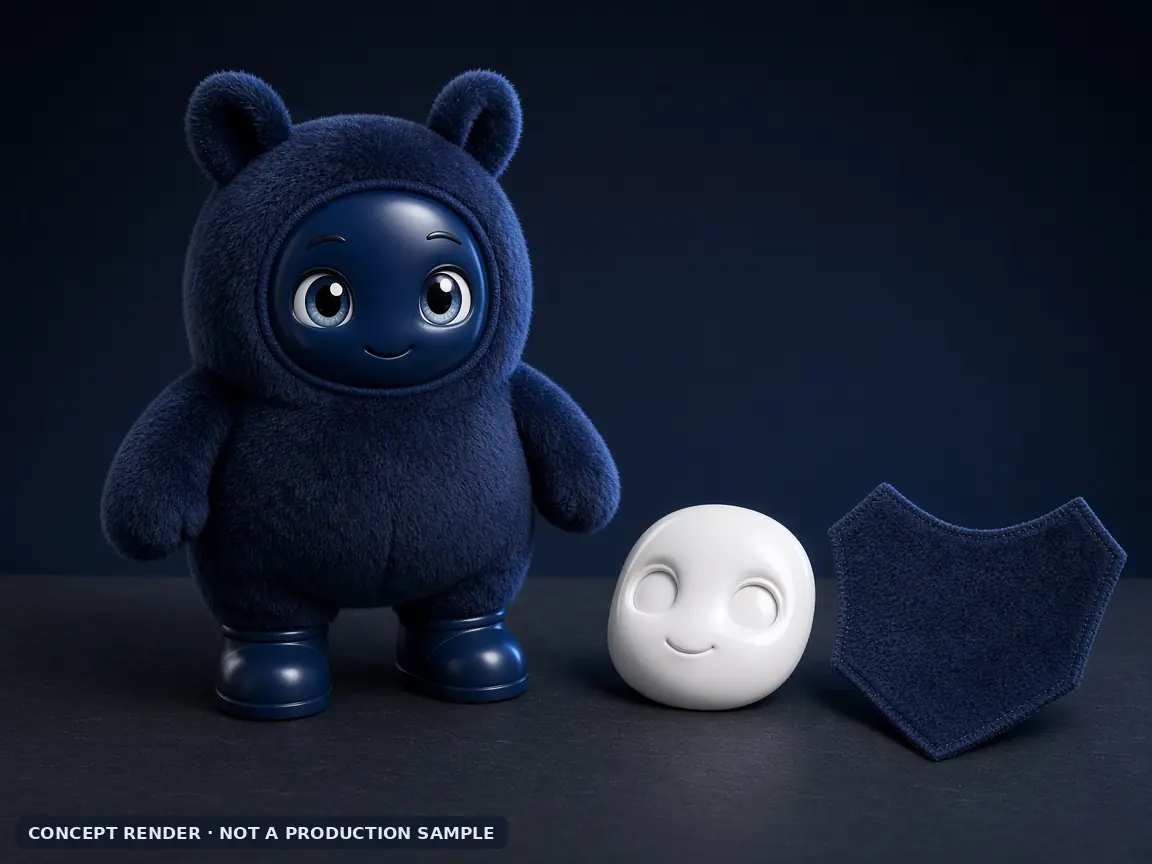
Hybrid Plush Figures: Combining Soft Fabrics with Molded Components
Some character designs require more than conventional fabric construction. Hybrid plush figures, often sold as vinyl plush toys, can combine soft textile bodies with selected molded components, such as a vinyl face, to create distinctive facial features, structural details or collectible effects.
Can manufacturers combine plush with molded plastic parts? Yes, when the parts are engineered together: molded faces, boots or accessories need attachment points the sewing team can reach, a weight the plush body can carry, and connections that survive handling. Molded PVC and ABS parts follow the same sculpt, tooling and painting workflow as our custom PVC figures. For a technical look at how the fabric opening, reinforcement and internal support are engineered around a molded face, see how hybrid plush figures are built.
Possible components
- Plush Body
- Molded PVC or ABS Face Components
- Rigid Decorative Accessories
- Internal Structural Elements
- Customized Connections
Resin components may be considered for appropriate display-oriented applications, but fragility, weight, attachment integrity and intended user age must be evaluated carefully.
Engineering considerations
Development may require:
- Material Compatibility
- Part Weight
- Attachment Methods
- Stitching Access
- Connection Durability
- Balance and Stability
- Applicable Safety Requirements
A hybrid figure is not automatically suitable for children's play. Rigid connections, detachable parts and small-part risks are assessed for the intended age group and destination market.
Discuss a Hybrid Plush ProjectSelecting the Right Fabrics and Construction
Which fabrics can be used for custom plush toys? Common choices include minky, velboa, short-pile plush, faux fur and fleece, plus other suitable textiles. Fabrics are not interchangeable: each one changes how the character looks and feels, how sharp the embroidery reads, how the panels sew and what the toy costs.
- Appearance
- Texture
- Softness
- Shape
- Embroidery
- Sewing
- Durability
- Production Cost
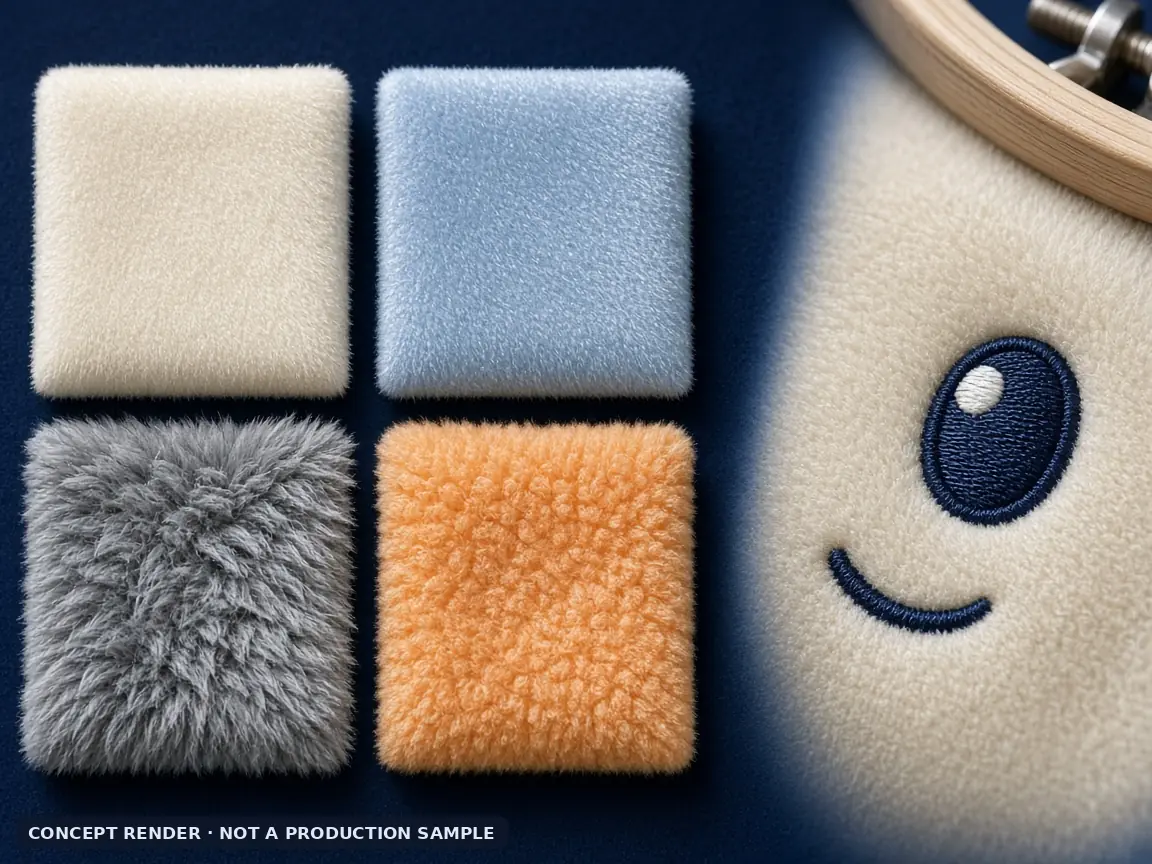
| Material | Typical Feel | Applications | Considerations |
|---|---|---|---|
| Minky | Very soft, smooth, short dense pile with a slight sheen | Character plush, collectibles, premium gifts | Holds embroidery well; the pile direction affects color and sheen, so panels must be cut consistently. |
| Velboa | Short, low pile; smooth and slightly firmer | Mascots, promotional plush, crisp-shaped designs | Keeps clean shapes and seams; less plush-like feel than minky; typically a cost-conscious choice. |
| Short-Pile Plush | Soft, uniform pile of moderate length | General character plush, stuffed animals | Balances softness and detail; longer pile can blur small embroidery and seams. |
| Faux Fur | Long, fluffy, textured pile | Realistic animals, manes, tails, accent parts | Hides fine details and seams; may need trimming around faces; usually higher material cost and shedding control. |
| Fleece | Soft brushed surface, little or no pile, matte | Dolls, clothing, budget-friendly plush, accessories | Easy to sew and color-stable; flatter look; can pill depending on the grade. |
Fabric grades vary by supplier and composition. The fabric for your project is confirmed on swatches and on the approved sample; filling is usually polyester fiberfill, with other filling systems evaluated per product.
Our Custom Plush Toy Development Process
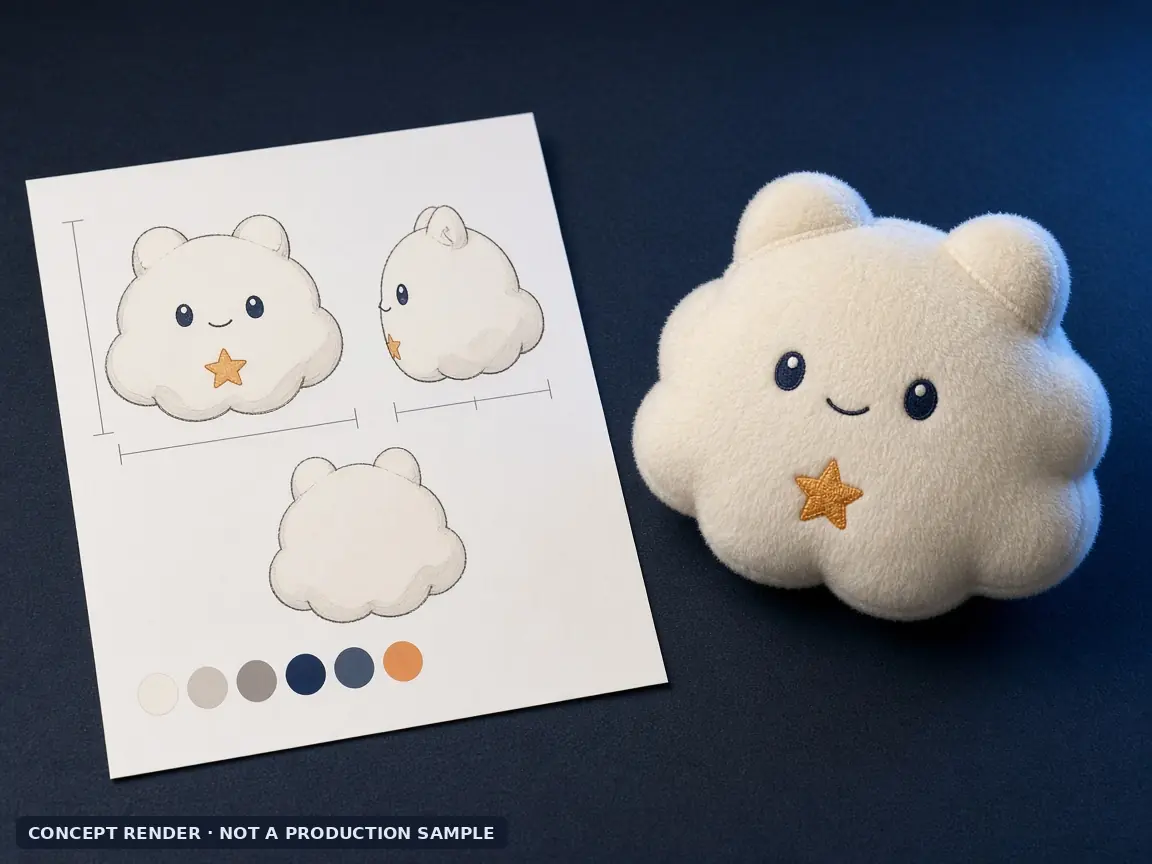
How are custom plush toys developed? A character moves from artwork to flat patterns, to a first sample, through revisions to an approved sample, and only then into production. The interactive view below follows one original demo character through those stages.
Design to Finished Plush
Select a stage, use Previous / Next, or the arrow keys.
Artwork and design review
We start from your character artwork — ideally front, side and back views with colors, target size and any must-keep details. A 3D model helps but is not required.
Your input: Artwork files, target dimensions, quantity per design, intended market and age group.
Pattern making
Plush pattern making translates the 2D character into flat fabric pieces: front and back panels, gussets that create depth, ears and limbs, embroidery placement and seam allowances. Pile direction and stuffing openings are planned at this stage.
Your input: Feedback on proportions and which features matter most to the character's identity.
Prototype sample
A first sample shows how fabric, pattern and filling actually behave. Ear position, face placement, fill distribution and seam lines are reviewed — revisions at this stage are normal.
Your input: Written or marked-up photo comments on the sample.
Approved sample
After revisions, the final sample, material specifications, labels and packaging are signed off. The final approved sample provides the production reference.
Your input: Sample approval and packaging approval.
Production and inspection
Cutting, embroidery, sewing, stuffing and hand finishing follow the approved sample. Inspections compare production units with the reference before packing and shipment.
Your input: Final inspection arrangements and shipping terms.
- STEP 1
Design Review
Review the original artwork, character proportions, dimensions, quantity and intended use.
- STEP 2
Pattern Development
Translate the character into suitable fabric patterns and sewing structures.
- STEP 3
Fabric & Color Selection
Review material texture, colors, embroidery and decorative details.
- STEP 4
Prototype Sampling
Create an initial plush sample for appearance, structure and feasibility review.
- STEP 5
Sample Revision
Refine proportions, facial details, stitching, stuffing and accessories.
- STEP 6
Pre-Production Approval
Approve the final sample, material specifications and packaging requirements.
- STEP 7
Production & Quality Control
Coordinate cutting, embroidery, sewing, stuffing, finishing and inspections.
- STEP 8
Packaging & Shipping
Complete approved packaging, final inspection and shipment arrangements.
The final approved sample provides the production reference.
Sampling is iterative: most characters need one or more revisions to get proportions, face placement and fill right, and the number of rounds depends on the design. The revision scope is agreed in the quotation. See how our general project flow works on the manufacturing process page, or learn how patterns, sewing and stuffing work in our plush toy manufacturing guide.
A Manufacturing Partner for Character-Based Products
Plush sits alongside our other custom toy lines, so one team can coordinate a character across soft and molded products.
Character Development
Support the transition from illustrations and concepts to production-ready toy specifications.
Multi-Material Coordination
Coordinate plush, PVC, ABS and selected hybrid product development within one project workflow.
Sample-Based Production Control
Use approved samples and specifications to establish the production reference.
Project Communication
Support overseas customers through design review, quotation, sampling, production coordination and shipment planning.
Quality Control for Custom Plush Manufacturing
Quality standards are set per product, target market and the approved sample. Typical inspection points:
Fabric Inspection
Incoming fabric checked for defects, pile and hand feel against the approved material.
Color and Texture Review
Color and texture compared with approved swatches and the sample.
Pattern Accuracy
Cut pieces checked against the approved pattern so shape and proportions stay consistent.
Embroidery Quality
Placement, density, thread color and clean edges on faces and logos.
Stitching and Seam Inspection
Seam strength, stitch consistency and closed stuffing openings.
Stuffing Consistency
Fill weight and distribution checked so the shape and hand feel match the sample.
Attachment Security
Eyes, accessories and any rigid parts checked for secure attachment.
Surface Appearance
Loose threads, stains, pile damage and overall finish.
Packaging Inspection
Labels, hangtags, polybags, retail boxes and carton marks as approved.
Safety and compliance are assessed per product and market
Plush toys for different age groups and markets face different requirements. For children's toys, testing to the toy safety requirements of the sales market may be required. Depending on the actual product, the review may consider:
- EN 71 (EU)
- ASTM F963 (US)
- US CPSIA
- Applicable chemical and textile material requirements
- Small parts
- Attachment security
- Seams and stuffing
- Age grading
- Labels and warnings
We do not claim that every design, accessory or material is automatically compliant in every market. Test requirements, test plans and labs are confirmed per project; hybrid plush needs extra review of rigid connections, detachable parts and small parts.
What Affects Custom Plush Toy Costs?
What affects MOQ and pricing? Mainly the size, the number of unique designs, fabric, pattern complexity, decoration, accessories, filling, packaging and the quantity per design.
- Product Size
- Number of Unique Designs
- Fabric Selection
- Pattern Complexity
- Embroidery
- Printing
- Accessories
- Stuffing
- Packaging
- Quantity Per Design
MOQ
Minimum order quantities vary depending on plush size, construction, fabric, design complexity and production requirements.
Plush MOQs are evaluated per project; injection-molded figure MOQs do not apply to plush.
Sampling
Sample costs and development time depend on design complexity, materials and revision requirements. Both are confirmed in the quotation before sampling starts.
Pricing
A quotation should clearly identify:
- Sample Development
- Unit Production
- Packaging
- Applicable Testing
- Freight and Trade Terms
What information is required for an OEM plush quotation?
Send these details through our contact form (the message field accepts all of them) or include links to your artwork files:
- Artwork or character sheet (front, side and back views if available)
- Target dimensions
- Number of designs
- Estimated quantity per design
- Fabric and material preferences
- Embroidery, printing and accessory requirements
- Packaging format
- Destination market and intended age group
- Target schedule
Packaging Built Around Your Channel
Packaging is developed from the product dimensions, branding and distribution requirements: individual polybags and hangtags for promotional runs, printed window or gift boxes for retail, and export cartons sized for the order. Warning labels and markings follow the destination market.
Need packaging for figures as well? See our custom toy packaging options.
Custom Plush Toy FAQ
Can you manufacture plush toys from my original character design?
Yes. Original artwork and clear design references can be used for an initial feasibility review and pattern-development discussion.
Do I need a 3D model to make a custom plush toy?
Not necessarily. Clear 2D artwork with multiple views and detailed specifications is often suitable for starting development.
What is the MOQ for custom plush toys?
MOQ depends on size, design, materials, decoration and production requirements. Each project is evaluated separately.
Can I choose the fabric?
Yes. Suitable fabric types, textures and colors can be reviewed during development.
Can you make custom mascot plush toys?
Yes. Mascot-based plush development can be evaluated from original artwork or authorized brand designs.
Can you produce custom embroidered faces?
Suitable embroidery techniques can be used for many facial details, depending on the design and fabric.
Can you develop plush toys with plastic faces?
Yes. Hybrid development can combine suitable plush and molded components, subject to engineering and product-safety review.
Can different character designs share the same production order?
Multiple designs can be evaluated together, but minimum quantities and production setup may still apply to each individual design.
How many sample revisions are included?
The revision scope should be established during quotation according to the project requirements.
Can you provide custom packaging?
Custom packaging can be developed based on the product dimensions, branding and distribution requirements.
Can the finished toys meet European or US safety requirements?
Applicable testing and compliance requirements must be assessed according to the actual product, intended age group and destination market.
How do I request a custom plush toy quote?
Provide artwork, dimensions, number of designs, quantity per design, material preferences, decorative requirements and intended market.
Ready to Turn Your Character into a Custom Plush Toy?
Share your original artwork, target dimensions, estimated quantity and customization requirements. Our team can review the project and discuss a suitable development and manufacturing approach.
Get a Custom Plush QuoteAll product images on this page are concept renders of original Hanyang demo characters created for illustration. They are not photos of production samples or customer projects.